Tuesday, September 22

These are not full-fledged computers that run on Microsoft's Windows software, but it can be used to keep track of online friends, view photos as they are updated in real-time, listen to Internet radio, share personal photos and enjoy music and photo collections that are stored on other networked computers. Apple is rumored to be working on something similar, but it is not expected until next year and it may even cost more.
The $249 DreamScreen 100 has a 10.2-inch and the $299 DreamScreen 130 has a 13.3-inch screen. They come with two gigabytes (GB) of built-in memory for storing photos, music, and home movies directly on the device. They have a universal serial bus (USB) and flash memory card connectors so that can be used to load digital content from a USB drive or digital camera.
HP has also included a new service called HP SmartRadio, which aggregates streams of live Internet broadcasts from more than 10,000 radio stations around the world. Users can now listen to their favorite radio stations on the Internet by location or genre in any part of their home.
Tuesday, September 22 0
Bangalore: The Indian Space Research Organization (ISRO) will launch seven satellites in 1,200 seconds, similar to the launch in April 2008 when it launched 10 satellites, on Wednesday from Sriharikota.
ISRO will put six nano satellites and one major ocean satellite into orbit, as the final 51 hour countdown began on Monday morning. Out of the six nano satellites, four are from Germany; one is from Switzerland and one from Turkey. The seventh is a big one, India's Oceansat-2 weighing 960 kilograms.

It will take 1200 seconds from the time of launch to ejection of satellites. As Oceansat-2 will be ejected after 1,055 seconds, the other four nano satellites will be ejected in the next 45 seconds. Two others will stay with the fourth stage of the rocket which will be on its own once the different stages of the rocket get separated.
The order of ejection is similar to the April 2008 launch featuring one big satellite, Cartosat-2A and nine other nano satellites. Once the Polar Satellite Launch Vehicle (PSLV) takes off and reaches a certain height and velocity, it will first launch the Oceansat-2 and few seconds later, the first of four nano satellites will be launched. These satellites will be launched every 10-12 seconds one after the other.
"The rocket re-orients itself every time a satellite is to be placed in orbit. The re-orientation ensures one satellite doesn't collide with another. The rocket effectively re-orients itself four to five times in the space of one flight," explained a scientist.
The rocket's brain would make all calculations in advance, from ejection of first satellite to the fifth. The exact moment of ejection and then re-orientation for the next ejection is worked out in advance. All mathematical calculations on the ground, launch sequence and flight path have to work on zero error.
"There is no room for error. The rocket has to be in flight till the last minute which means all systems on board have to function to perfection. Once the first and second stages separate and the fourth stage (the engines) stop, the ejection process begins until every satellite circulates in orbit," said an official.
Oceansat-2 is India's second satellite to study oceans and their interaction with the atmosphere. It is the 16th remote sensing satellite of India. It is in a cuboid shape with two solar panels projecting from its sides. The satellite will map fishing zones around India, measure ocean surface, wind speeds, atmospheric temperature and humidity.
This mission is PSLV's 16th, as from September 1993 to April 2009, PSLV has been launched 15 times. With fourteen successful launches, it failed only once.
"It is known that PSLV has been a very successful launch vehicle. Countries realise it is a vehicle or rocket very well suited for launch of nano satellites. We were on to our 16th mission with PSLV and Germany and Swtizerland were looking for a mission. Our needs coincided and that's how we have the six nano satellites," said S Satish, Spokesperson, ISRO.
New York: A 13-year-old Indian girl from Lucknow, Yugratna Srivastava has won the honour to address U.S. President Barack Obama, President Hu Jintao of China and other world leaders on behalf of the world's three billion youth and children.
The UN summit that Yugratna would address Tuesday is part of the UN Secretary General Ban Ki-moon's campaign to bring about a fair and ratifiable green house gas reduction agreement at this year's Climate Conference in Copenhagen, Denmark.
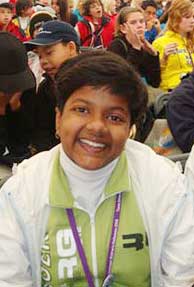
"World leaders must recognise the energy and potential which lies in children and youth. This age group is just like flowing rivers and they make their own way in the direction in which they march," said Yugratna, a lively, committed and very passionate teenager.
Yugratna became sensitised to environmental protection in Grade 6 in St. Francis School in Shamli, India. It was there that she joined "Tarumitra" (Friends of Trees).
The non-governmental organisation works hard to stop the felling of trees and forests, builds roadside gardens and cleans up garbage dumps, among other activities.
In 2008 Yugratna participated in the Tunza youth conference in Norway organised by the United Nations Environment Programme (UNEP) and became a member of the Junior Board. Tunza is the UNEP magazine for youth.
She is the first Indian child to ever get elected to the Junior Board and was invited again to participate in this year's Tunza conference in Seoul.
When she is not in school, she is talking about climate change and environmental protection around India and abroad.
"For my generation in India, climate change means global warming, scarcity of food and drinking water and an outbreak of accentuated epidemics," she added.
Her increasing environmental activism has brought her to the attention of UNEP and now to the world leading to her addressing the UN Summit in New York.